Showing posts with label Pure Land. Show all posts

Saturday, May 19, 2012

Reading the Pure Land Sutras


Preparation
When reading any of the Buddhist Sutras it is best that one's mind be calm and concentrated.  A short period of meditative concentration prior to reading a Sutra will help one to understand and appreciate its meaning.  Reciting the Buddha's name is an excellent practice prior to reading one of the Pure Land Sutras.  One should also try to generate a sense of gratitude prior to reading a Sutra, for the words of a Sutra are a path to Liberation.  One may simply extend the gratitude of one's heart to the Buddhas, Bodhisattvas and sentient beings as well as to the Sutra itself.  A gesture of gratitude such as lighting a stick of incense, making a bow or ringing a bell is also reasonable, and produces a peaceful, mindful atmosphere in which the Sutra may be deeply appreciated.
Reading a Sutra
When engaged in the reading of a Sutra, try to go neither too quickly nor too slowly.  Simply read at a comfortable pace.  If one is unfamiliar with some of the terminology encountered in the Sutras, it is helpful to have some kind of a reference book nearby so that one may find definitions quickly.
There will be times when a particular passage in a Sutra will not be understood by the reader.  If this is the case, try reading that passage again.  If the passage is still not understood, try reading it a third time.  If, after three tries, the meaning of the passage is still unclear, simply continue reading the Sutra.  Since the information in the hard-to-understand passage has been read three times, a karmic seed has been planted which will blossom at a future time.  At that time, one's understanding of the meaning of the particular passage will become clear.  Try not to become frustrated if the meaning of a passage or passages is unclear.  All things become evident eventually if one's intent is sincere.
Ending the Reading
When you have finished reading the Sutra either in whole or in part, simply put it down and allow the meaning of what you have just read to "settle in."  If you wish to silently contemplate what you have just read, that is also reasonable.  Don't try too hard to understand everything you've read, just go over it gently in your mind with a heart of appreciation for the teachings encountered in the Sutra.
After contemplation, one may once again extend one's thanks to the Buddhas, Bodhisattvas, sentient beings and the Sutra itself.

Pure Land/Ch'an Meditation Practice

T'ien-t'ai master, Chih-i

Combined Practice 
The unified practice of Ch'an and Pure Land is the unified practice of Compassion and Widsom. Pure Land practice allows one to open up the heart, thus developing Compassion; Ch'an practice shows one how to concentrate the mind, thus developing Wisdom. When Compassion and Wisdom combine in a dynamic relationship, our True Mind is realized, our True Heart comes forth, and Enlightenment is assured.  This form is practiced in contemporary Ch’an monasteries around the world.  The combination of Ch'an and Pure Land has existed since the eighth century C.E.  Awakening to one’s true nature shows us how we’re linked with universal compassion and wisdom, and becoming one with universal compassion and wisdom shows us our true nature.  There really is no inherent conflict.
Pure Land Hua-T'ou Practice
The Ch'an form which is most widely used in combination with Pure Land is hua-t'ou practice.  The term "hua-t'ou" literally means "the head of a thought" and refers to the mind which exists before we turn it into so-called "thought" or "thoughts."  Hua-t'ou practice usually centers around a "who?" question such as, "Who is this?" or "Who am I?"  Eventually, the question simply becomes, "Who?"  The hua-t'ou method produces a sustained meditative inquiry into one's true nature.  This sustained meditative inquiry leads to a feeling of "doubt," which in turn intensifies one's meditative inquiry until a breakthrough occurs.
Pure Land hua-t'ou practice generally centers around the question, "Who is reciting the Buddha's name?"  As in other hua-t'ou practices, the question eventually becomes, "Who?"  However, instead of simply asking the question setting up the meditative inquiry, Pure Land hua-t'ou practice adds the practice of Buddha-Recitation.  Practitioners are instructed to engage in Buddha-Recitation for several minutes before beginning to ask the question, "Who is reciting the Buddha's name?"  When the meditative inquiry sparked by the question begins to fade, the practitioners go back to Buddha-Recitation until they are ready to inquire again (It should be noted that anyone who engages in this or any Ch'an-based practice should do so under the guidance of a qualified teacher who can assist the practitioner along the way).
This practice is also known as Self-Nature Buddha Recitation since the realm which is revealed by the mind of meditation is the Pure Land itself.  The eminent contemporary Ch'an master Hsuan-Hua addressed this when he said, "As we recite 'Namo Amitabha Buddha' we each create and adorn our own Land of Ultimate Bliss.  We each accomplish our own Land of Ultimate Bliss which is certainly not hundreds of thousands of millions of Buddhalands from here.  Although it is far away it doesn’t go beyond one thought.  It’s not hundreds of thousands of millions of Buddhalands from here; it’s right in our hearts.  The Land of Ultimate Bliss is the original true heart, the true mind, of every one of us.  If you obtain this heart, you will be born in the Land of Ultimate Bliss.  If you don’t understand your own original true heart, you will not.  The Land of Ultimate Bliss is within our hearts, not outside.  Amitabha Buddha and living beings do not discriminate between this and that, for the Land of Ultimate Bliss is not so far away.  In one thought, turn the light within.  Know that you are the Buddha, and your original Buddhahood is just the Land of Ultimate Bliss."
In the book "Road to Heaven," Bill Porter interviewed Abbot Hsu-Tung of Hsiangchi Temple, the most famous Pure Land temple in China. Venerable Hsu-Tung, when asked about the difference between Zen and Pure Land practice, said the following: "In Zen, we keep asking who's chanting the name of the Buddha.  All we think about is where the name of the Buddha is coming from.  We keep asking,until we find out who we were before we were born.  This is Zen.  We sit with one mind.  And if the mind runs off somewhere, we follow it wherever it goes, until the mind finally becomes quiet, until there's no Zen to Zen, no question to question, until we reach the stage where we question without questioning and without questioning we keep questioning.  We keep questioning, until we finally find an answer, until delusions come to an end, until we can swallow the world, all its rivers and mountains, everything, but the world can't swallow us, until we can ride the tiger, but the tiger can't ride us, until we find out who we really are.  This is Zen.
"In Pure land practice, we just chant the name of the Buddha, nothing more.  We chant with the mind.  We chant without making a sound, and yet the sound is perfectly clear.  And when we hear the sound, the chant begins again.  It goes around and around.  the chant doesn't stop, and the mind doesn't move.  The sound arises, we hear the sound, but our mind doesn't move.  And when our mind doesn't move, deulsions disapper.  And once they're gone, the one mind chants.  The result is the same as Zen.  Zen means no distinctions.  Actually, Pure Land practice includes Zen, and Zen practice includes Pure Land.  If you don't practice both, you become one-sided."

Amitabha Recitation Practice


About Recitation

The recitation of the name of Amitabha Buddha is practiced by at least as many people as practice seated meditation worldwide.  Recitation practice is easy to do, extrememly portable, and produces deep levels of meditative concentration.  The aim of Buddha-Recitation practice is Buddhanusmrti, or "Buddha-Remembrance Samadhi," a state in which both the name and qualities of the Buddha of Boundless Compassion and Wisdom are kept in mind at all times.

Many people, unfortunately, think that the mere repetition of "Namo Amitabha Buddha," "Amitabha Buddha" or "Amitabha" is sufficient for Buddhanusmrti.  Merely repeating the name is not enough; it is important to keep the qualities of Amitabha, particularly Compassion and Wisdom, in the mind while reciting.  Simple repetition of the Buddha's name, "cruise-control recitation" if you like, eventually produces a state of dullness and boredom.  Reciting the Buddha's name while concentrating on Compassion and Wisdom for instance, produces great energy, concentration and joy.  As we will see, there are a number of variations on reciting the Buddha's name. 

Ten Methods of Buddha-Recitation 

1. Breath-By-Breath Recitation: One recitation per in-breath, one per out-breath.  This is a basic recitation practice used to calm the mind.

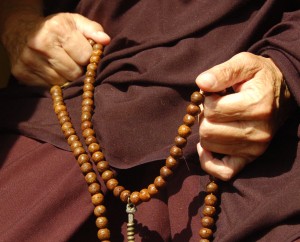
2. Recitation With Beads: Using a mala (Buddhist beads) is very helpful when one is reciting the Buddha’s name.  The standard mala has 108 beads.  One can record how many recitations one does each day until the need for recording is no longer present.

3. 10-Phrase Recitation:  This is simply 10 recitation of the Buddha’s name per bead, and is a good practice for people who have trouble with wandering thoughts.

4. Bowing to the Buddha Recitation:  Reciting the Buddha’s name before or during a bow.  The bow may be at the waist with palms together, or may be a full prostration in which one places one’s forehead to the floor and raises the hands above the ears.  This  is a good practice for combating drowsiness because it utilizes the body, mouth and mind simultaneously.

5. Linked Recitation:  Each word and phrase “rests its head” on the previous one, producing a strong recitative flow and deep concentration.

6. Reflecting Recitation:  The practice of examining each word and phrase which is recited to make sure they are clear and distinct, until only the name remains.  Essentially, this is turning the mind inward on its sense of hearing.

7. Calming Light Recitation:  One visualizes sitting in the midst of an immense transparent zone of light while reciting the Buddha’s name.  This is a very calming practice for those who experience disturbing images such as fears or bad memories.

8. Lotus Blossom Recitation:  This recitative practice utilizes the traditional four colors of the Lotus blossom (blue, yellow, red and white).  One visualizes a large blue lotus emitting blue light before one’s eyes with each recitation.  The process is then repeated for each color in sequence.  As the lotus flowers appear, one may imagine a soft lotus fragrance.

9. Visualization Recitation: This recitative practice involves reciting the Buddha’s name while practicing the 13th visualization from the Visualization Sutra, that of a 60-foot tall Amitabha Buddha standing at the edge of a seven-jeweled pond. 

10. Enlightened, Illuminating Recitation:  This dual practice consists of reciting the Buddha’s name while at the same time turning one’s attention on one’s True Nature until the only thing that remains is the consciousness of having united the “mind of the body” and the True Mind of the Buddha.  This form of recitation is considered to be a very high-level practice and is most meaningful for those who have gained experience and insight through experiencing most of the preceding recitation practices.

Pure Land Buddhism - 5 Elements Practices

Sukhavati

 The Role of Meditation in Pure Land Buddhism


Meditation is central to the practice of Buddhism.  Siddhartha's meditation under the Bodhi Tree was the practice that produced a Buddha, an Awakened one.  Realizing this, all Buddhist schools employ meditative forms to assist sentient beings to realize their True Nature.


The Five Elements School of Meditative Pure Land Buddhism emphasizes meditative practice as a way of understanding and actualizing the Pure Land path.  All five elements have a meditative aspect to them, which is useful in helping us to become one with Boundless Compassion and Wisdom.  As has been mentioned elsewhere on this site, practice is simply one aspect of the Pure Land Tripod of Practice, Aspiration and Faith.  Essentially all three legs of the Tripod are one, but we may use the meditative leg to facilitate a deeper understanding of the Pure Land path. 


In our experience it is easier for many 21st-century Westerners to enter the Pure Land path through the practice of meditation.  The meditative practices of Pure Land Buddhism began even before the time of Master Hui-Yuan.  The Visualization Sutra is considered to be a master handbook for those who wish to engage in very dynamic visualization meditation practice, and even the simple act of reciting Amitabha Buddha's name is meditative in nature.  In his work, "The Zen Koan As a Means of Attaining Enlightenment," the famous author D. T. Suzuki pointed out that the kind of meditative concentration (Sk. Samadhi) which is realized in Buddha-Recitation is no different that that which is realized in the study and practice of the Zen koan. 


The five practices which are described in this section (Sutra Study, Atonement & Veneration, Recitation, Meditation and Visualization) all have the potential to produce great amounts of meditative concentration if we approach them sincerely, energetically and patiently.  That meditative concentration will then guide us to the realization of our Purified Mind and the Pure Land in which we have never stopped dwelling.  May all sentient beings benefit from the Five Elements practices so that Boundless Compassion and Wisdom will manifest everywhere!


[SOURCE]

Pure Land Visualization Meditation

The practice of Visualization is considered to be one of the most powerful meditative practices in the Buddhist tradition.  Whatever the mind can conceive can be visualized, including the vision of the Buddha Amitabha and the Pure Land.  Visualization practice produces a great deal of meditative concentration (Skt. Samadhi) and it also serves to purify unimaginable amounts of harmful karma.  When one attains a clear vision of Amitabha Buddha and the Pure Land, one is said to have attained Nien-Fo Samadhi (Skt. Buddhanusmrti Samadhi).

In the Visualization Sutra, the Buddha instructs Vaidehi to first call up the image of a setting sun, then to inspect it closely, and finally to perceive or "see" the setting sun in the mind.  This is the basis of Pure Land Visualization Meditation. 

The Practice

It is common to use the 16 visualizations outlined in the Visualization Sutra as the objects of one's  Pure Land Visualization practice.  However, a word of caution is prudent at this juncture.  One should not try to do all 16 visualizations in one sitting unless one has been doing this practice for many months, or even years.  The First Visualization, the Visualization of the Setting Sun, is designed as sort of a "warm-up" exercise to get one accustomed to the process of visualization which will be described below.  A much less strenuous visualization is the Purification Visualization, which may be accessed here.

It is also possible to use a single image such as the Buddha Amitabha or the Bodhisattva Kuan-Yin as the object of Visualization Meditation if one desires.  The visualizations of the Visualization Sutra do become very complex, but one should not be intimidated by them if one has done single-minded visualization practice.

The following steps are recommended when doing Visualization Meditation:

Purifying One's Karma.  Recite the following three times:

I acknowledge all deluded karmic actions I have performed through countless cycles of birth and death;
 
Fueled by my endless greed, anger and ignorance,
 
And manifested through my bodily actions, speech and thought.
 
I acknowledge and confess this karma, thereby purifying it.

Dissolving of the Elements and Senses.  

After assuming a comfortable posture and spending a few minutes regulating the breath, do the following:

Dissolve the earth (solid) elements of the body (skin, muscles, tendons, bones, etc.) followed by the sense of smell.

Dissolve the water (liquid) elements of the body followed by the sense of taste.

Dissolve the air (gaseous) elements of the body followed by the sense of touch.

Dissolve the fire (heat, energy, chi) elements of the body followed by the sense of sight.

Dissolve the space or emptiness element of the body followed by the sense of hearing.

All that remains is pure awareness.  Sit as this awareness for a few moments.

The Process of Visualization

Step 1: Imagine/Call Up/Remember/Look At an image.  This means to go into your mind and either recall or construct an image.

Step 2: Inspect/Study/Analyze/Examine Closely the image in your mind.  Using your mind, look at the details of the image you have called up in very, very fine detail.  Omit nothing.  Be thorough.

Step 3: See/Hold/Perceive/View this image.  Using the power of your mind, try as hard as you can to sustain this image clearly.

Another way to look at this process is:

- Construct an image mentally (even if it comes from a visual source).
- Impress this image on your consciousness by looking at it closely.
- Maintain this image as long as you can so that it stays present.

Mutual Support in the Visualization Process 

Remember: Each step in visualization is supported by the step that precedes it.

So whenever it becomes difficult to hold the image in your mind (Step 3), return to examining it closely (Step 2).  Whenever it becomes difficult to examine the mental image closely (Step 2), just restart the entire process (Step 1).  By relying on the principle of Mutual Support, the practice of Visualization Meditation retains its dynamic nature.  With plenty of time, practice and patience, the practice will become stronger and stronger until you can visualize the objects of your meditation clearly at any time.  At that point there is no difference between the mind and the relative world.

[SOURCE]

Thursday, May 17, 2012

History of Meditative Pure Land Practice


The unified practice of Ch'an and Pure Land, known in Chinese as "Ch'an-ching I-chih," has a long history. As early as the 4th century C.E., Master Hui-Yuan (334-416), considered to the be first Pure Land Ancestor, incorporated meditative discipline into Pure Land practice.

Master Hui-Yuan (334-416)
 Tao-Hsin (580-651), the Fourth Ancestor of the Ch'an school, taught what he called the "Samadhi of Oneness," utilizing the recitation of the Buddha's name to pacify the mind. It should be noted that since this practice involved reciting the name of any Buddha (a practice dating back to the origins of Buddhism) it was not specifically designed to produce rebirth in the Realm of Bliss, but it did act as a bridge linking Ch'an and Nien-Fo practices. Tao-Hsin taught that the Pure Mind is the Pure Buddha-Land.

The unified practice was also advocated by the Fifth Ch'an Ancestor Hung-Jen (601-674) who saw recitation as a good practice for beginners. Hung-Jen also advocated the visualization practices laid out in the Visualization Sutra.

Tao-Hsin (580-651)
Buddha recitation not concerned with rebirth was taught by a number of Hung-Jen's disciples including Fa-Chih (635-702), the Fourth Ancestor of the Ox-Head School of Ch'an. It was also put forth by the Ching-Chung School which was descended from Chih-Hsien, one of the Fifth Ch'an Ancestor's 10 eminent disciples, in the early 8th century C.E.

Descendents of Chih-hsien who advocated the unified practice included Wu-Hsiang, a former Korean prince who made invocational Nien-Fo practice a key part of the Dharma Transmission Ceremony. Although the practice was still not centered around Buddha Amitabha or rebirth in the Realm of Bliss, it marked the first time that Nien-Fo practice was explicitly adopted as part of a Ch'an school. Subsequent schools which taught Nien-Fo as part of their training included the Pao-T'ang School, the Hsuan-Shih Nien-Fo Ch'an School and the Nan-Shan Nien-Fo Ch'an School.

Ancestor Tz'u-Min (679-748) is said to have been the first Pure Land Ancestor to advocate harmonizing Pure Land practice and Ch'an. Tz'u-min developed his Pure Land faith after a pilgrimage to India, where he was inspired by stories centered around Buddha Amitabha and Bodhisattva Avalokitesvara.

Tuesday, April 10, 2012

Infinite Life Sutra

Wherever the Buddha's teachings flourish,
either in cities of countrysides,
people will gain inconceivable benefits.
The land and people will be enveloped in peace.
The sun and moon will shine clear and bright.
Wind and rain will appear accordingly
and there will be no disasters.
Nations will be prosperous
and there will be no need for soldiers or weapons.
People will abide by morality and accord with laws.
They will be courteous and humble,
and everyone will be content without injustices.
There will be no thefts or violence.
The strong will not dominate the weak
and everyone will get their fair share.

Monday, July 13, 2009

Doctrinal Doubts About Pure Land

Question:

The Pure Land method is not for those of high capacities, who should follow the Zen or Mind-Only school. Moreover, people should have strong wills, be independent and rely on their own strength to become emancipated. Is it not a sign of weakness to depend on the other-power of Amitabha Buddha?

Answer:

I will answer this question by referring first to the capacities of sentient beings and then to the issue of self-power vs. other-power.

1. Pure Land embraces people of all capacities -- whether limited, moderate or high. Sentient beings of limited and moderate capacities who recite the Buddha's name can rid themselves of afflictions and karmic obstacles and develop merit, virtue and wisdom, leading in time to the state of samadhi. They will then be reborn within the nine "lotus grades" of the Land of Ultimate Bliss, the exact grade depending on the amount of effort they exert in cultivation.

Those of high capacities, on the other hand, enter deeply into the state of samadhi and wisdom as soon as they begin uttering the Buddha's name. Whether walking, standing, lying down or sitting, they are always in the "Buddha Recitation Samadhi." After death they will be reborn in the highest lotus grade. Some of the sages of old who entered this realm described it in the following terms:

Holding the rosary, I am rid of worldly thoughts, Suddenly, I already became a Buddha a long time ago.

Thus, Pure Land embraces people of all levels. For those of high capacities it is a sublime method; for those of limited capacities it turns into a simple method.

High-ranking masters of the Buddhist canon often commented:

The Buddha Recitation method encompasses the Zen, Sutra Studies, Discipline (Vinaya) and Esoteric (Tantric) Schools.

Why is it that Buddha Recitation encompasses all four schools? It is because when reciting the Buddha's name, we rid ourselves of all deluded thoughts and attachments, which is Zen . The sacred words "Amitabha Buddha" contain innumerable sublime meanings, hidden in and springing forth from those words, which is the Sutra Studies School. Reciting the Buddha's name at the deepest level stills and purifies the three karmas (of mind, speech and body), which is the Discipline School. The words "Amitabha Buddha" have the same effect as a mantra, eliminating grievances and wrongs, severing evil karma, granting wishes and subduing demons. This is the Esoteric School.

For example, during a year of long, severe drought, the Great Master Lien Ch'ih, instead of reciting the "rain mantra," just walked around the countryside hitting his gong while reciting the Buddha's name. It was reported that wherever he went, the rain would begin to fall. There is also the case of the Elder Zen Master Yuan Chao Pen, who, rather than practice meditation, would just recite the sacred words "Amitabha Buddha." In the process, he became enlightened to the Original Nature and attained the Buddha Recitation Samadhi. Extrapolating from the above, the words "Amitabha Buddha" include the Five Periods and the Eight Teachings [i.e., all the teachings of Buddha Sakyamuni] and encompass all the paramitas.

The Meditation Sutra further teaches:

A single wholehearted recitation of Buddha Amitabha's name will obliterate all the heavy karma committed in [eight billion eons] of Birth and Death. (J.C. Cleary, Pure Land, Pure Mind.)

If Pure Land followers can concentrate their minds, they are bound to develop wisdom, as with other methods. In addition, since they recite the Buddha's name while in concentration, their evil karma and obstructions will easily be dissolved, and they will attain a high degree of merit and wisdom much sooner. For this reason, Elder Master Lien Ch'ih lauded the Buddha Recitation method as "great samadhi" "great wisdom," "areas merit and virtue," and "great emancipation."

According to the Meditation Sutra, if anyone who has committed the "Five Grave Offenses" or "Ten Evil Deeds" sees evil omens appear as he is on the verge of death, he need only recite the Buddha's name one to ten times with all his heart, and Buddha Amitabha will descend to welcome and escort him to the Pure Land. For an extremely sinful person to be saved and reach the stage of non-retrogression with just a few recitations of Buddha Amitabha's name is quite an accomplishment. The Patriarch Yin Kuang has these words of praise:

Persons of the highest capacities can attain samadhi if they practice Buddha Recitation with an undisturbed mind. Those of the lowest capacities will still succeed with only ten utterances [as they may be reborn in the Pure Land and ultimately achieve samadhi and Buddhahood]. This is an outstanding feature not found in any other method.

2. As far as the question of "self-power" vs. "other power" is concerned, it is wrong to understand the Pure Land method as exclusive reliance on Buddha Amitabha's power. The Pure Land practitioner should use all his own power to rid himself of afflictions, while reciting to the point where his mind and the Mind of Amitabha Buddha are in unison. At that moment, in this very life, the Buddha will emit rays to silently gather him in and at his death, he will be welcomed and guided back to the Pure Land. The "welcoming and escorting" feature is really the principal manifestation of the "other-power."

As an analogy, for a student to exert his own efforts to the utmost is, of course, a laudable thing. If, in addition, he has the benefit of an excellent teacher who follows his progress and assists him, his level of achievement will be higher, resulting in assured success in his final examinations.

Adding other-power to self-power is similar. Therefore, how can it be considered weak or mistaken to exert all of our own efforts to cultivate and then seek additional help to achieve rapid success?

The great and lofty Pure Land method is lauded by such great Bodhisattvas and Patriarchs as Manjusri, Samantabhadra, Asvaghosha, Nagarjuna as well as eminent Masters of various schools and traditions. To belittle Buddha Recitation is to belittle these very Bodhisattvas, Patriarchs and high-ranking Masters. To claim that Buddha Recitation is low-level, relying only on other-power, is to lack a real understanding of the Pure Land method.

Buddhism of Wisdom & Faith: Pure Land Principles and Practice
Dharma Master Thich Thien Tam Translated and edited by the Van Hien Study Group Sutra Translation Committee of the United States and Canada

Wednesday, July 8, 2009

Buddha Recitation and the Four Practices

Sentient beings usually differ in preferences and innate capacities. Therefore, although they may engage in the common practice of Buddha Recitation, they are bound to differ somewhat in their practice. For this reason, ancient masters have summarized four types of practice: Ch'an-Pure Land; Sutra Recitation-Pure Land; Esotericism-Pure Land; Exclusive Pure Land Practice.

The first category of cultivators comprises those who engage primarily in Buddha Recitation but practice Ch’an as well. They are said to practice Ch’an-Pure Land also called dual practice of Ch’an and Pure Land. Here, rebirth in the Pure Land is the principal goal, while seeing the True Nature and becoming enlightened to the Way is a secondary matter which depends on the individual practitioner's good roots and conditions.

The second category comprises those whose main practice is Buddha Recitation with Sutra Recitation as an ancillary practice. They are said to practice Sutra Recitation-Pure Land. As for the sutras chanted, some prefer the Diamond Sutra or the Amitabha Sutra, while others prefer the Avatamsaka Sutra or Lotus Sutra, or else individual chapters, such as the "Avalokitesvara Chapter" (Lotus Sutra, ch. 25) or the Chapter on "Samantabhadra's Practices and Vows" (Avatamsaka Sutra, ch. 40).

The third category is composed of those who engage in Buddha Recitation as their primary practice and Mantra Recital as an ancillary one. They follow the practice of Esotericism-Pure Land. The mantras vary with the practitioner and include such dharani as the Great Compassion Mantra, the Thousand-Armed Avalokitesvara Dharani, the Rebirth Dharani, etc.

The fourth category of cultivators comprises those who practice Buddha Recitation diligently and exclusively without cultivating other methods. Within this group, those of high capacities practice the Sixteen Meditations as taught in the Meditation Sutra, while the great majority only practice oral recitation of the Buddha's name.

The Pure Land Patriarch Shan Tao and Ch’an Master Yung Ming are traditionally believed to be transformation bodies of Amitabha Buddha. However, Master Shan Tao taught diligent Buddha Recitation alone; Ch’an Master Yung Ming, on the other hand, in addition to reciting the Buddha's name one hundred thousand times each day also engaged in other practices, totaling 108 in all.* The Patriarch Yin Kuang once commented in this regard:

They both teach rebirth in the Pure Land, but the method followed by Master Shan Tao is designed to help those of limited or moderate capacities and belongs to the exclusive Pure Land practice. Master Yung Ming's method, on the other hand, aims specifically to encourage those of the highest capacity, and belongs to the perfect practice.

People in the Dharma-Ending Age are generally of limited or moderate capacities. For this reason, among the four methods discussed above, they should, perhaps, choose Exclusive Pure Land practice, in order to ensure rebirth in the Land of Ultimate Bliss. However, each person is different in preferences and innate capacity and cannot be coerced. Therefore, while he may practice several methods concurrently, the Pure Land practitioner must be attentive and clear in his mind as to the two aspects of Practice: principal and subsidiary. The emphasis should always be on the principal aspect, i.e., Buddha Recitation. Only in this way will he follow the path of cultivation without obstacles and without missing the goal of rebirth in the Pure Land.

*100,000 recitations: this number is often cited in commentaries as an ideal for the very serious Pure Land cultivator. 108 recitations: another commonly cited figure, equivalent to the number of beads in a long rosary.
------------------------------------------------------------------------------------------------
Buddhism of Wisdom & Faith: Pure Land Principles and Practice
Dharma Master Thich Thien Tam Translated and edited by the Van Hien Study Group Sutra Translation Committee of the United States and Canada

Wednesday, May 13, 2009

The Ten Recitation Method

This simple, convenient, and effective way to practice Buddha name chanting is especially suitable for those who find that they have little time for cultivation. The chanting helps us to be mindful of Amitabha Buddha and brings us joy.

We begin when we wake up. Sit up straight and clearly chant "Amituofo" ten times with a calm and focused mind, aloud or silently. We repeat this eight more times during the day, each time chanting "Amituofo" ten times. This chanting can be done by following one of two schedules. Please choose the one that is the most suitable for your circumstances.

One schedule is to chant upon waking up,

before and after breakfast,

before work,

before and after lunch,

before and after dinner,

and before retiring.

The other schedule is to chant upon waking up,

before breakfast,

before and after our morning’s work,

before lunch,

before and after our afternoon’s work,

before dinner,

and before retiring.