About Recitation
The recitation of the name of Amitabha Buddha is practiced by at least as
many people as practice seated meditation worldwide. Recitation practice
is easy to do, extrememly portable, and produces deep levels of meditative
concentration. The aim of Buddha-Recitation practice is Buddhanusmrti,
or "Buddha-Remembrance Samadhi," a state in which both the name and
qualities of the Buddha of Boundless Compassion and Wisdom are kept in mind at
all times.
Many people, unfortunately, think that the mere repetition of "Namo
Amitabha Buddha," "Amitabha Buddha" or "Amitabha" is
sufficient for Buddhanusmrti. Merely repeating the name is not enough; it
is important to keep the qualities of Amitabha, particularly Compassion and
Wisdom, in the mind while reciting. Simple repetition of the Buddha's
name, "cruise-control recitation" if you like, eventually produces a
state of dullness and boredom. Reciting the Buddha's name while
concentrating on Compassion and Wisdom for instance, produces great energy,
concentration and joy. As we will see, there are a number of variations
on reciting the Buddha's name.
Ten Methods of Buddha-Recitation
1.
Breath-By-Breath Recitation: One recitation per in-breath, one per
out-breath. This is a basic recitation practice used to calm the mind.
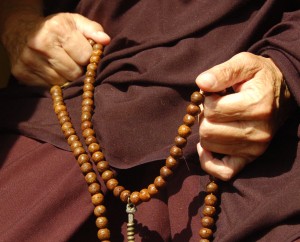
2. Recitation With Beads: Using a mala (Buddhist beads) is very helpful when one is reciting the Buddha’s name. The standard mala has 108 beads. One can record how many recitations one does each day until the need for recording is no longer present.
3. 10-Phrase Recitation: This is simply 10 recitation of the Buddha’s name per bead, and is a good practice for people who have trouble with wandering thoughts.
4. Bowing to the Buddha Recitation: Reciting the Buddha’s name before or during a bow. The bow may be at the waist with palms together, or may be a full prostration in which one places one’s forehead to the floor and raises the hands above the ears. This is a good practice for combating drowsiness because it utilizes the body, mouth and mind simultaneously.
5. Linked Recitation: Each word and phrase “rests its head” on the previous one, producing a strong recitative flow and deep concentration.
6. Reflecting Recitation: The practice of examining each word and phrase which is recited to make sure they are clear and distinct, until only the name remains. Essentially, this is turning the mind inward on its sense of hearing.
7. Calming Light Recitation: One visualizes sitting in the midst of an immense transparent zone of light while reciting the Buddha’s name. This is a very calming practice for those who experience disturbing images such as fears or bad memories.
8. Lotus Blossom Recitation: This recitative practice utilizes the traditional four colors of the Lotus blossom (blue, yellow, red and white). One visualizes a large blue lotus emitting blue light before one’s eyes with each recitation. The process is then repeated for each color in sequence. As the lotus flowers appear, one may imagine a soft lotus fragrance.
9. Visualization Recitation: This recitative practice involves reciting the Buddha’s name while practicing the 13th visualization from the Visualization Sutra, that of a 60-foot tall Amitabha Buddha standing at the edge of a seven-jeweled pond.
10. Enlightened, Illuminating Recitation: This dual practice consists of reciting the Buddha’s name while at the same time turning one’s attention on one’s True Nature until the only thing that remains is the consciousness of having united the “mind of the body” and the True Mind of the Buddha. This form of recitation is considered to be a very high-level practice and is most meaningful for those who have gained experience and insight through experiencing most of the preceding recitation practices.
2. Recitation With Beads: Using a mala (Buddhist beads) is very helpful when one is reciting the Buddha’s name. The standard mala has 108 beads. One can record how many recitations one does each day until the need for recording is no longer present.
3. 10-Phrase Recitation: This is simply 10 recitation of the Buddha’s name per bead, and is a good practice for people who have trouble with wandering thoughts.
4. Bowing to the Buddha Recitation: Reciting the Buddha’s name before or during a bow. The bow may be at the waist with palms together, or may be a full prostration in which one places one’s forehead to the floor and raises the hands above the ears. This is a good practice for combating drowsiness because it utilizes the body, mouth and mind simultaneously.
5. Linked Recitation: Each word and phrase “rests its head” on the previous one, producing a strong recitative flow and deep concentration.
6. Reflecting Recitation: The practice of examining each word and phrase which is recited to make sure they are clear and distinct, until only the name remains. Essentially, this is turning the mind inward on its sense of hearing.
7. Calming Light Recitation: One visualizes sitting in the midst of an immense transparent zone of light while reciting the Buddha’s name. This is a very calming practice for those who experience disturbing images such as fears or bad memories.
8. Lotus Blossom Recitation: This recitative practice utilizes the traditional four colors of the Lotus blossom (blue, yellow, red and white). One visualizes a large blue lotus emitting blue light before one’s eyes with each recitation. The process is then repeated for each color in sequence. As the lotus flowers appear, one may imagine a soft lotus fragrance.
9. Visualization Recitation: This recitative practice involves reciting the Buddha’s name while practicing the 13th visualization from the Visualization Sutra, that of a 60-foot tall Amitabha Buddha standing at the edge of a seven-jeweled pond.
10. Enlightened, Illuminating Recitation: This dual practice consists of reciting the Buddha’s name while at the same time turning one’s attention on one’s True Nature until the only thing that remains is the consciousness of having united the “mind of the body” and the True Mind of the Buddha. This form of recitation is considered to be a very high-level practice and is most meaningful for those who have gained experience and insight through experiencing most of the preceding recitation practices.


