Showing posts with label Meditation. Show all posts

Tuesday, May 29, 2012

The Heavens of Meditation

There are three parts:

1. The Four Meditations in the Realm of Form (Rupa-Dhatu)

2. The Four Meditations in the Realm of Formlessness (Arupa-Dhatu)

3. The Cessation (Nirodha Samapatti)

The Four Meditations in the Realm of Form

The fours basic levels of meditation (S. Dhyana) are in the realm of form, pure of the distractions of sensory desire. One progressively sublimates the senses. It has been likened to a turtle that withdraws its head and legs into its shell. Each progressive stage is a more pure state of Samadhi (mental concentration). They are:

The First Basic Meditation:

The stage of bliss that comes from detachment and freedom from emotional distress (klesas) - This emotional distress includes evil desires (origination, karmic causes) and evil states or conditions (sufferings, retributions).

1. VitarkaAwakening - Initial attention, application of cognitive thought onto an object.
It is likened to a bee hovering about a flower

2. VicaraObservation -  Continuous, sustained observation on an object, entailing a cognitive, analytical scrutiny of it & discerment of reality from falsehood (pravicaya-dharma). It is likened to a bee landing on a flower and gathering its pollen

3. PritiJoy - An ecstatic, emotional feeling of knowing, revelation & oneness with an object. It is not a cognitive state but rather an affective and intuitive state of mind.

4. SukhaContentment - A more sublime affective and intuitive state of knowing and familiarization with an object of meditation. It is a less emotional, more refined state of bliss.

5. SamadhiConcentration - Singless of mind, complete focus, and pure mental concentration

The First Basic Meditation has the least strength of Samadhi.
The first two steps are cognitive/verbal states of mind whereas the second two are affective/intuitive. Each state of mind is more sublime than the preceding state. The affective states of mind are subtler than the cognitive states, with contentment being subtler than rejoicing. Only the single mind is completely pure.

The Second Basic Meditation:

The stage of bliss that comes from the sublimation of the cognitive functions of the mind - There is gradual withdrawal of the cognitive states of mind so that there is only concentration and the affective states of mind.

First the wandering, initial attention (vitarka) is sublimtaed, then the more subtle, sustained scrutiny is eliminated.

In sublimating the initial attention (vitarka) and the sustained thought (vicara) one further purifies singleness of mind (Samadhi). One's concentration will continue to produce the affective states of joy and contentment without the cognitive functions.

1. Visuddhi - Inner Purity - Becoming purified of the applied cognitive thought (vitarka) and then becoming purified of the sustained cognitive thought (vicara).

2. Priti  - Joy - Feekings of ecstasy and revelation as one is able to transcend the verbal, cognitive states of mind and enter deeper levels of concentration

3.  Sukha - Contentment - New levels of refined bliss

4.  Samadhi - Concentration - Singlenes of mind, pure mental concentration

The Second Basic Meditation has greater strength of Samadhi.
The cognitive, verbal states of mind are eliminated and consequently there is greater singleness of mind.

The Third Basic Meditation:

A state of refined bliss. One lets go of the ecstatic emotions of joy and abides in mindfulness (a steady, continuous presence of mind), spiritual insight, & concentration of mind. One continues to feel the less intense & more sublime affective state of bliss.

1. PrasrabdhiRenunciation - Letting go; sublimating the ecstatic emotions of joy

2. SmritiMindfulness - Remembrance; a steady, continuous presence of mind

3. Prajna - Insight - Spiritual insight into the nature of reality and the mind

4. Sukha Contentment - Spiritual bliss; a most sublime affective state of mind

5. SamadhiConcentration - Singleness of mind; pure mental concentration

The Third Basic Meditation has great strength of Samadhi, having been freed to all cognitive states of mind as well as the all but the most subtle affective states of mind.

The Fourth Basic Meditation:

The stage of equanimity, free of both cognitive (verbal) and affective (emotional) states of mind. No affective states of mind remain as one reaches the highest level of pure mental concentration.

1. PrasrabdhiRenunciation - All affective states of mind are completely eliminated

2. Smriti Mindfulness - Completely steady and continuous presence of mind

3. UpeksaEquanimity - Impartiality; Complete freedom from and indifference to all subconscious disturbance, including suffering, joy and contentment

4.  Samadhi Concentration - Singlenss of mind; pure mental concentration

The Fourth Basic Meditation: Samadhi is completely attained.

The Meditations in the Four Realms of Formlessness:

The next four meditations (the four emancipations) are in the formless realm, where the limitations of the body and the barriers and multiplicity of physical objects are transcended. One is emancipated from the limitations of the senses and the physical realm and one enters into the four realms of formlessness:

A. The Boundlessness of Empty Space

B. The Boundlessness of Consciousnes

C. The Boundlessness of Nothingness

D. The Boundlessness of That Which Is Neither With Nor Without Perception
Nirodha Samapatti

Finally there is the last meditation, complete withdrawal or Attainment of Cessation (Nirodha Samapatti); In this state of ‘mindlessness’ (acittaka), close to that of coma and death, the practitioner has minimal heartbeat, respiration & body heat, and does not respond to external stimulus

The Buddha saw little to no soteriological benefit in these formless states of meditation.

This is the highest level of the six spiritual realms in the threefold realm. All of the above was part of the system of meditation known at the time of the Buddha Sakyamuni. None of this offers escape from the mortality of the threefold realm and the cycles of life & death (Samsara)

[SOURCE]

Thursday, May 24, 2012

How To Practice Ch'an Meditation

Ch’an practice attracts shallow and deep interest in the world. The world is a reflection of the mind and the Ch’an method is nothing other than the instant and profound realisation of this fact. There is nothing else to it. The mind realises its own essence and in so doing no longer perceives itself and the outer world as two separate and unconnected realities. Such a realisation has profound philosophical implications, but these implications must not cloud the ordinary mind with excessive intellectual concerns. These implications are understood with a natural ease free of effort. Effort is only required by the unrealised mind striving to understand some thing that lies beyond its reach. This is why the Ch’an masters of old advised their students to ‘lay it all down’ and ‘have no concern for the world’. It is true that examples abound in the Ch’an literature of people becoming enlightened through a word, a phrase or an act, usually delivered by a master at the appropriate moment, but much of this activity is the product of a long and sustained meditative practice where through hours of meditation the practitioner has previously built-up the inner potential so that at the right moment a break through can occur. This break through may happen whilst sitting in meditation, or it may occur in ordinary life moments that happen between meditation sessions.

Whatever the case, a break through in the mind can not happen if the ordinary mind is not brought firmly under control. The ordinary (ignorant) flow of mind that goes about its everyday existence merely perpetuates itself without end, and does not possess an ability to calm itself and put an end to suffering. This type of ordinary mind merely follows a cycle of suffering from which it can not escape. Therefore it is essential that part of the day is used to reign in the mind so that it does not do what it wants, when it wants to do it. The mind is use to doing what it wants ever since it occupied a baby’s body – the habit is difficult to break, but broken it must be. The Ch’an method does not engage the ordinary conscious flow of the mind, as that would be piling an illusion upon an illusion – instead the Ch’an method seeks the empty Mind Ground by directly looking for it with no hesitation whatsoever. The human mind, the body it occupies, and the world it inhabits, are all products of the ordinary, unenlightened state of mind and should be given no attention at all. The mind must be disengaged from the attachment to the ordinary mind, the body and the environment. The Ch’an practitioner must turn the gaze firmly within, away from externals toward the empty Mind Ground so that its essence can be fully realised and integrated with, thus eradicating the illusion of duality and attaining the realisation that all things exist within a great and profound, all-embracing emptiness.

Saturday, May 19, 2012

Pure Land/Ch'an Meditation Practice

T'ien-t'ai master, Chih-i

Combined Practice 
The unified practice of Ch'an and Pure Land is the unified practice of Compassion and Widsom. Pure Land practice allows one to open up the heart, thus developing Compassion; Ch'an practice shows one how to concentrate the mind, thus developing Wisdom. When Compassion and Wisdom combine in a dynamic relationship, our True Mind is realized, our True Heart comes forth, and Enlightenment is assured.  This form is practiced in contemporary Ch’an monasteries around the world.  The combination of Ch'an and Pure Land has existed since the eighth century C.E.  Awakening to one’s true nature shows us how we’re linked with universal compassion and wisdom, and becoming one with universal compassion and wisdom shows us our true nature.  There really is no inherent conflict.
Pure Land Hua-T'ou Practice
The Ch'an form which is most widely used in combination with Pure Land is hua-t'ou practice.  The term "hua-t'ou" literally means "the head of a thought" and refers to the mind which exists before we turn it into so-called "thought" or "thoughts."  Hua-t'ou practice usually centers around a "who?" question such as, "Who is this?" or "Who am I?"  Eventually, the question simply becomes, "Who?"  The hua-t'ou method produces a sustained meditative inquiry into one's true nature.  This sustained meditative inquiry leads to a feeling of "doubt," which in turn intensifies one's meditative inquiry until a breakthrough occurs.
Pure Land hua-t'ou practice generally centers around the question, "Who is reciting the Buddha's name?"  As in other hua-t'ou practices, the question eventually becomes, "Who?"  However, instead of simply asking the question setting up the meditative inquiry, Pure Land hua-t'ou practice adds the practice of Buddha-Recitation.  Practitioners are instructed to engage in Buddha-Recitation for several minutes before beginning to ask the question, "Who is reciting the Buddha's name?"  When the meditative inquiry sparked by the question begins to fade, the practitioners go back to Buddha-Recitation until they are ready to inquire again (It should be noted that anyone who engages in this or any Ch'an-based practice should do so under the guidance of a qualified teacher who can assist the practitioner along the way).
This practice is also known as Self-Nature Buddha Recitation since the realm which is revealed by the mind of meditation is the Pure Land itself.  The eminent contemporary Ch'an master Hsuan-Hua addressed this when he said, "As we recite 'Namo Amitabha Buddha' we each create and adorn our own Land of Ultimate Bliss.  We each accomplish our own Land of Ultimate Bliss which is certainly not hundreds of thousands of millions of Buddhalands from here.  Although it is far away it doesn’t go beyond one thought.  It’s not hundreds of thousands of millions of Buddhalands from here; it’s right in our hearts.  The Land of Ultimate Bliss is the original true heart, the true mind, of every one of us.  If you obtain this heart, you will be born in the Land of Ultimate Bliss.  If you don’t understand your own original true heart, you will not.  The Land of Ultimate Bliss is within our hearts, not outside.  Amitabha Buddha and living beings do not discriminate between this and that, for the Land of Ultimate Bliss is not so far away.  In one thought, turn the light within.  Know that you are the Buddha, and your original Buddhahood is just the Land of Ultimate Bliss."
In the book "Road to Heaven," Bill Porter interviewed Abbot Hsu-Tung of Hsiangchi Temple, the most famous Pure Land temple in China. Venerable Hsu-Tung, when asked about the difference between Zen and Pure Land practice, said the following: "In Zen, we keep asking who's chanting the name of the Buddha.  All we think about is where the name of the Buddha is coming from.  We keep asking,until we find out who we were before we were born.  This is Zen.  We sit with one mind.  And if the mind runs off somewhere, we follow it wherever it goes, until the mind finally becomes quiet, until there's no Zen to Zen, no question to question, until we reach the stage where we question without questioning and without questioning we keep questioning.  We keep questioning, until we finally find an answer, until delusions come to an end, until we can swallow the world, all its rivers and mountains, everything, but the world can't swallow us, until we can ride the tiger, but the tiger can't ride us, until we find out who we really are.  This is Zen.
"In Pure land practice, we just chant the name of the Buddha, nothing more.  We chant with the mind.  We chant without making a sound, and yet the sound is perfectly clear.  And when we hear the sound, the chant begins again.  It goes around and around.  the chant doesn't stop, and the mind doesn't move.  The sound arises, we hear the sound, but our mind doesn't move.  And when our mind doesn't move, deulsions disapper.  And once they're gone, the one mind chants.  The result is the same as Zen.  Zen means no distinctions.  Actually, Pure Land practice includes Zen, and Zen practice includes Pure Land.  If you don't practice both, you become one-sided."

Amitabha Recitation Practice


About Recitation

The recitation of the name of Amitabha Buddha is practiced by at least as many people as practice seated meditation worldwide.  Recitation practice is easy to do, extrememly portable, and produces deep levels of meditative concentration.  The aim of Buddha-Recitation practice is Buddhanusmrti, or "Buddha-Remembrance Samadhi," a state in which both the name and qualities of the Buddha of Boundless Compassion and Wisdom are kept in mind at all times.

Many people, unfortunately, think that the mere repetition of "Namo Amitabha Buddha," "Amitabha Buddha" or "Amitabha" is sufficient for Buddhanusmrti.  Merely repeating the name is not enough; it is important to keep the qualities of Amitabha, particularly Compassion and Wisdom, in the mind while reciting.  Simple repetition of the Buddha's name, "cruise-control recitation" if you like, eventually produces a state of dullness and boredom.  Reciting the Buddha's name while concentrating on Compassion and Wisdom for instance, produces great energy, concentration and joy.  As we will see, there are a number of variations on reciting the Buddha's name. 

Ten Methods of Buddha-Recitation 

1. Breath-By-Breath Recitation: One recitation per in-breath, one per out-breath.  This is a basic recitation practice used to calm the mind.

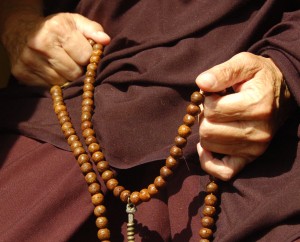
2. Recitation With Beads: Using a mala (Buddhist beads) is very helpful when one is reciting the Buddha’s name.  The standard mala has 108 beads.  One can record how many recitations one does each day until the need for recording is no longer present.

3. 10-Phrase Recitation:  This is simply 10 recitation of the Buddha’s name per bead, and is a good practice for people who have trouble with wandering thoughts.

4. Bowing to the Buddha Recitation:  Reciting the Buddha’s name before or during a bow.  The bow may be at the waist with palms together, or may be a full prostration in which one places one’s forehead to the floor and raises the hands above the ears.  This  is a good practice for combating drowsiness because it utilizes the body, mouth and mind simultaneously.

5. Linked Recitation:  Each word and phrase “rests its head” on the previous one, producing a strong recitative flow and deep concentration.

6. Reflecting Recitation:  The practice of examining each word and phrase which is recited to make sure they are clear and distinct, until only the name remains.  Essentially, this is turning the mind inward on its sense of hearing.

7. Calming Light Recitation:  One visualizes sitting in the midst of an immense transparent zone of light while reciting the Buddha’s name.  This is a very calming practice for those who experience disturbing images such as fears or bad memories.

8. Lotus Blossom Recitation:  This recitative practice utilizes the traditional four colors of the Lotus blossom (blue, yellow, red and white).  One visualizes a large blue lotus emitting blue light before one’s eyes with each recitation.  The process is then repeated for each color in sequence.  As the lotus flowers appear, one may imagine a soft lotus fragrance.

9. Visualization Recitation: This recitative practice involves reciting the Buddha’s name while practicing the 13th visualization from the Visualization Sutra, that of a 60-foot tall Amitabha Buddha standing at the edge of a seven-jeweled pond. 

10. Enlightened, Illuminating Recitation:  This dual practice consists of reciting the Buddha’s name while at the same time turning one’s attention on one’s True Nature until the only thing that remains is the consciousness of having united the “mind of the body” and the True Mind of the Buddha.  This form of recitation is considered to be a very high-level practice and is most meaningful for those who have gained experience and insight through experiencing most of the preceding recitation practices.

Pure Land Buddhism - 5 Elements Practices

Sukhavati

 The Role of Meditation in Pure Land Buddhism


Meditation is central to the practice of Buddhism.  Siddhartha's meditation under the Bodhi Tree was the practice that produced a Buddha, an Awakened one.  Realizing this, all Buddhist schools employ meditative forms to assist sentient beings to realize their True Nature.


The Five Elements School of Meditative Pure Land Buddhism emphasizes meditative practice as a way of understanding and actualizing the Pure Land path.  All five elements have a meditative aspect to them, which is useful in helping us to become one with Boundless Compassion and Wisdom.  As has been mentioned elsewhere on this site, practice is simply one aspect of the Pure Land Tripod of Practice, Aspiration and Faith.  Essentially all three legs of the Tripod are one, but we may use the meditative leg to facilitate a deeper understanding of the Pure Land path. 


In our experience it is easier for many 21st-century Westerners to enter the Pure Land path through the practice of meditation.  The meditative practices of Pure Land Buddhism began even before the time of Master Hui-Yuan.  The Visualization Sutra is considered to be a master handbook for those who wish to engage in very dynamic visualization meditation practice, and even the simple act of reciting Amitabha Buddha's name is meditative in nature.  In his work, "The Zen Koan As a Means of Attaining Enlightenment," the famous author D. T. Suzuki pointed out that the kind of meditative concentration (Sk. Samadhi) which is realized in Buddha-Recitation is no different that that which is realized in the study and practice of the Zen koan. 


The five practices which are described in this section (Sutra Study, Atonement & Veneration, Recitation, Meditation and Visualization) all have the potential to produce great amounts of meditative concentration if we approach them sincerely, energetically and patiently.  That meditative concentration will then guide us to the realization of our Purified Mind and the Pure Land in which we have never stopped dwelling.  May all sentient beings benefit from the Five Elements practices so that Boundless Compassion and Wisdom will manifest everywhere!


[SOURCE]

Pure Land Visualization Meditation

The practice of Visualization is considered to be one of the most powerful meditative practices in the Buddhist tradition.  Whatever the mind can conceive can be visualized, including the vision of the Buddha Amitabha and the Pure Land.  Visualization practice produces a great deal of meditative concentration (Skt. Samadhi) and it also serves to purify unimaginable amounts of harmful karma.  When one attains a clear vision of Amitabha Buddha and the Pure Land, one is said to have attained Nien-Fo Samadhi (Skt. Buddhanusmrti Samadhi).

In the Visualization Sutra, the Buddha instructs Vaidehi to first call up the image of a setting sun, then to inspect it closely, and finally to perceive or "see" the setting sun in the mind.  This is the basis of Pure Land Visualization Meditation. 

The Practice

It is common to use the 16 visualizations outlined in the Visualization Sutra as the objects of one's  Pure Land Visualization practice.  However, a word of caution is prudent at this juncture.  One should not try to do all 16 visualizations in one sitting unless one has been doing this practice for many months, or even years.  The First Visualization, the Visualization of the Setting Sun, is designed as sort of a "warm-up" exercise to get one accustomed to the process of visualization which will be described below.  A much less strenuous visualization is the Purification Visualization, which may be accessed here.

It is also possible to use a single image such as the Buddha Amitabha or the Bodhisattva Kuan-Yin as the object of Visualization Meditation if one desires.  The visualizations of the Visualization Sutra do become very complex, but one should not be intimidated by them if one has done single-minded visualization practice.

The following steps are recommended when doing Visualization Meditation:

Purifying One's Karma.  Recite the following three times:

I acknowledge all deluded karmic actions I have performed through countless cycles of birth and death;
 
Fueled by my endless greed, anger and ignorance,
 
And manifested through my bodily actions, speech and thought.
 
I acknowledge and confess this karma, thereby purifying it.

Dissolving of the Elements and Senses.  

After assuming a comfortable posture and spending a few minutes regulating the breath, do the following:

Dissolve the earth (solid) elements of the body (skin, muscles, tendons, bones, etc.) followed by the sense of smell.

Dissolve the water (liquid) elements of the body followed by the sense of taste.

Dissolve the air (gaseous) elements of the body followed by the sense of touch.

Dissolve the fire (heat, energy, chi) elements of the body followed by the sense of sight.

Dissolve the space or emptiness element of the body followed by the sense of hearing.

All that remains is pure awareness.  Sit as this awareness for a few moments.

The Process of Visualization

Step 1: Imagine/Call Up/Remember/Look At an image.  This means to go into your mind and either recall or construct an image.

Step 2: Inspect/Study/Analyze/Examine Closely the image in your mind.  Using your mind, look at the details of the image you have called up in very, very fine detail.  Omit nothing.  Be thorough.

Step 3: See/Hold/Perceive/View this image.  Using the power of your mind, try as hard as you can to sustain this image clearly.

Another way to look at this process is:

- Construct an image mentally (even if it comes from a visual source).
- Impress this image on your consciousness by looking at it closely.
- Maintain this image as long as you can so that it stays present.

Mutual Support in the Visualization Process 

Remember: Each step in visualization is supported by the step that precedes it.

So whenever it becomes difficult to hold the image in your mind (Step 3), return to examining it closely (Step 2).  Whenever it becomes difficult to examine the mental image closely (Step 2), just restart the entire process (Step 1).  By relying on the principle of Mutual Support, the practice of Visualization Meditation retains its dynamic nature.  With plenty of time, practice and patience, the practice will become stronger and stronger until you can visualize the objects of your meditation clearly at any time.  At that point there is no difference between the mind and the relative world.

[SOURCE]

Thursday, May 17, 2012

History of Meditative Pure Land Practice


The unified practice of Ch'an and Pure Land, known in Chinese as "Ch'an-ching I-chih," has a long history. As early as the 4th century C.E., Master Hui-Yuan (334-416), considered to the be first Pure Land Ancestor, incorporated meditative discipline into Pure Land practice.

Master Hui-Yuan (334-416)
 Tao-Hsin (580-651), the Fourth Ancestor of the Ch'an school, taught what he called the "Samadhi of Oneness," utilizing the recitation of the Buddha's name to pacify the mind. It should be noted that since this practice involved reciting the name of any Buddha (a practice dating back to the origins of Buddhism) it was not specifically designed to produce rebirth in the Realm of Bliss, but it did act as a bridge linking Ch'an and Nien-Fo practices. Tao-Hsin taught that the Pure Mind is the Pure Buddha-Land.

The unified practice was also advocated by the Fifth Ch'an Ancestor Hung-Jen (601-674) who saw recitation as a good practice for beginners. Hung-Jen also advocated the visualization practices laid out in the Visualization Sutra.

Tao-Hsin (580-651)
Buddha recitation not concerned with rebirth was taught by a number of Hung-Jen's disciples including Fa-Chih (635-702), the Fourth Ancestor of the Ox-Head School of Ch'an. It was also put forth by the Ching-Chung School which was descended from Chih-Hsien, one of the Fifth Ch'an Ancestor's 10 eminent disciples, in the early 8th century C.E.

Descendents of Chih-hsien who advocated the unified practice included Wu-Hsiang, a former Korean prince who made invocational Nien-Fo practice a key part of the Dharma Transmission Ceremony. Although the practice was still not centered around Buddha Amitabha or rebirth in the Realm of Bliss, it marked the first time that Nien-Fo practice was explicitly adopted as part of a Ch'an school. Subsequent schools which taught Nien-Fo as part of their training included the Pao-T'ang School, the Hsuan-Shih Nien-Fo Ch'an School and the Nan-Shan Nien-Fo Ch'an School.

Ancestor Tz'u-Min (679-748) is said to have been the first Pure Land Ancestor to advocate harmonizing Pure Land practice and Ch'an. Tz'u-min developed his Pure Land faith after a pilgrimage to India, where he was inspired by stories centered around Buddha Amitabha and Bodhisattva Avalokitesvara.

Thursday, May 21, 2009

Meditation On Buddha Shakyamuni


Prepare for this meditation by doing a few minutes of breathing meditation (focus your attention on your breath) to calm your mind. Then bring your attention to the suffering that all sentient beings undergo: the sufferings of heat and cold, hunger and thirst. Just as you experience many sufferings, remember that all mother sentient beings experience suffering at least equal to--if not greater than--your own. Determine to undertake this practice in order to awaken your own buddha-nature, quickly attain enlightenment and lead all other sentient beings to that same state of permanent, lasting happiness.

Visualization

The visualization of Lord Buddha is composed entirely of light, not mundane materials. In the space before you, at the level of your forehead, imagine a jewel-encrusted, golden throne. Each corner is supported by two snow lions with white bodies and turquoise manes and tails; these are the embodiment of bodhisattvas. On the flat surface of the throne is a fully opened lotus; this is symbolic of the awakened mind, arising from the mire of samsara. On the petals of the lotus are the flat disks of the sun and moon which serve as cushions for the Buddha, representing the Buddha's realizations of emptiness and bodhicitta. On the moon disk sits Buddha Shakyamuni.

Buddha's body is made of golden light. He is seated in the "full vajra" or lotus posture. He is dressed in the robes of a monk which do not actually touch his body, but are separated from it by about an inch. His face is very serene and beautiful; each hair on his head is individually curled to the right, not mingling with or touching others; his ear lobes are long; and his eyes are slightly opened.

His left hand rests in his lap in the meditation pose, holding a begging bowl, filled with nectar. The palm of his right hand rests on his right knee and his fingers touch the moon disk upon which he sits; this symbolizes his great control over anger, attachment and ignorance.

Taking Refuge

From your heart, recite the refuge prayer and visualize that streams of golden-white light radiate from the Buddha's body in all directions, blessing you and all sentient beings.

You may also visualize texts of Dharma teachings on thrones near the Buddha which emanate with the sounds of the teachings contained in them. Imagine teachers you have read or heard seated on similar thrones around the Buddha.

Imagine also that you are surrounded in space by all sentient beings in human form; your father and male friends and relatives are seated on your right; your mother and female friends and relatives are seated on your left; those you don't know and call "strangers" reach out to the vastness of space; those you call "enemies" are seated between you and the Merit Field of the Buddha, Dharma and Sangha, symbolic of anger in our mindstreams that separates us from feeling loving-kindness toward all beings and hinders our advancement to full buddhahood.

Imagine that you lead all these sentient beings in reciting the refuge prayer three times:

I take refuge until I am enlightened
In the Buddhas, the Dharma and the Sangha.
Through the positive potential I create by practicing generosityand the other far-reaching attitudes,
May I attain buddhahood for the benefit of all sentient beings.

Requests and Inspiration

From your heart, generate the request to the Buddha that he grant you inspiration to follow the path to full enlightenment; make this request on behalf of all living beings who are trapped in samsara.

Rays of light stream from the figure of the Buddha before you. This light enters your body and quickly removes all negativities, obscurations and hindrances, freeing you to progress quickly on the path. Imagine that this light flows not only to you, but to all living beings situated in space around you. Imagine that they all receive such inspiration and blessings as you recite the name mantra of Shakyamuni Buddha as many times as possible.

tayata om muni muni maha munaye soha

The Blessing of Body, Speech and Mind

Imagine that rays of light stream from the crown of Buddha's head to your crown; this light purifies the negatities of your body and removes the hindrances to attaining the enlightened body of a Buddha.

tayata om muni muni maha munaye soha

Rays of light then stream from the Buddha's throat to yours, pufifying the speech that communicates clearly to all sentient beings, regardless of their level or capacity.

tayata om muni muni maha munaye soha

Finally, rays of light emanate from the Buddha's heart and enter your own heart center. This light purifies the negativities of your mind and remove hindrances to the awakened, omniscient mind

tayata om muni muni maha munaye soha

Imagine that these light rays flow to all sentient beings, helping them to quickly reach a state of supreme awareness.

Maintain this visualization for as long as you can, reciting the mantra quietly to yourself or aloud and imagine that the light continues to stream from the Buddha to you and all sentient beings. Imagine that nectar accompanies the light and nourishes you completely, such is the nature of the Dharma.

Absorption

Imagine that the teachers and their thrones dissolve into light and are absorbed into the Buddha's body. Next, imagine that the texts and their thrones dissolve similarly and absorb into the Buddha. Imagine now that the throne is absorbed into the lotus, the lotus into the sun, the sun into the moon and the moon into the body of the Buddha. Buddha now comes to the crown of your head, facing the same direction as you, dissolves into brilliant, white light and dissolves into your body through the crown of your head, filling your body once again with this brilliant light.

Feel great bliss and joy as your body, speech and mind are completely transformed. Hold this feeling for as long as you can, experiencing the removal of all hindrances and obstructions to omniscience.

From this state, imagine in the space where you are sitting, arising from emptiness are the snow lions, the throne, lotus, sun and moon disks and yourself seated upon them in the same aspect as you visualized the Buddha before. Visualize and really feel that you have attained the state of omniscience; feel the enlightened compassion and wisdom of buddhahood.

At your heart appear sun and moon disks. At the center of the moon disk, standing upright, is the syllable MUM. Surrounding this are the syllables of Shakyamuni Buddha's name mantra:

tayata om muni muni maha munaye soha

Streams of light flow from the MUM and mantra at your heart center to all sentient beings, completely removing their hindrances, obstructions, wrong views, delusions and traces of ignorance and thereby transforming them into the form of the Buddha as well. Meditate in this way for as long as possible, reciting the mantra quietly to yourself.

This portion of the meditation is called "bringing the result into the path." It is a very powerful method for transforming our normal view of and how we behave in the world. The result of our practiceis to attain full enlightenment; this activity of bringing the result of buddhahood to our present state is a powerful, transformative tool. You should not imagine that your body, speech or mind are the same; they have arisen from emptiness and manifested in the form of a buddha. This activity enables you to transform yourself and surroundings into vehicles that lead to full, perfect enlightenment.

Dedication

When you have completed this meditation, dedicate the positive potential of this practice to the benefit of all living beings, that they may be liberated from the hardships of cyclic existence and placed in a state of perfect peace and happiness. Remind yourself that your initial motivation for doing this meditation is to actually attain such a state as the means to be able to lead all other sentient beings to full enlightenment.

In your daily routine, bring to mind the feeling and attitude that you felt when you were just imagining the state of buddhahood. When your activities become particularly stressful, remember that such a state comes about by grasping after your "I" or some sort of non-existent self, by putting the interests of this "self" before all other mother sentient beings. Simply remembering a peaceful, blissful state--filled with love and compassion--is often enough to relieve a stressful situation; such times can be transformed into happiness by such a rememberance.


At other times, when you want to eradicate all traces of a disturbing attitude, simply reciting the Buddha's mantra om muni muni maha munaye soha is often enough inspiration to transform that state into one of peace and happiness. Reminding yourself that you are a "Child of the Buddha" and wishing to attain happiness for yourself and others helps to gradually remove such states of mind completely. When you do so, remember to dedicate the merit or positive potential to all beings, that they might do the same.

From the FPMT Osel Shen Phen Ling Web Page